

Our FAQ brings together all the most frequently asked questions about our products.
FAQ
Marseille Soap
Traditional Marseille Soap is:
- a soap composed exclusively of vegetable oils, without chemical additives, preservatives, colorants or fragrance
- manufactured in cauldrons according to the Marseille saponification process
- geographical origin: the Marseille region
There are two types of Marseille soaps: green Marseille Soap and beige Marseille Soap. Both are saponified using the same process in cauldrons according to the traditional recipe. The difference between the two lies in their vegetable oil composition.
Green Soap is made from 100% olive pomace oil, known for its nourishing properties.
Beige Soap is made from 20% RSPO palm kernel oil and 80% RSPO palm oil, which have been used for over 200 years and were historically imported through French colonies. They improve the solid consistency of the soap for more practical use.
Both soaps (green and beige) are recommended for both personal hygiene and household cleaning (floors, etc.).
This formula is unique on the market and is composed exclusively of olive pomace oil.
Complying with the Colbert Edict of 1688, this traditional formula guarantees the detergent and cosmetic properties of Marseille Soap.
Multi-purpose, it is recommended for washing your hands, removing stains from clothes, making laundry detergent, or cleaning surfaces.
We pay great attention to our choice of vegetable oils to offer you excellent quality Marseille Soap. We follow the same manufacturing process and use the same varieties of oils for over two centuries, which is what makes our Marseille Soap authentic, sought after and appreciated for generations. Our oils come from the Mediterranean region for olive oil (Greece, Spain, Italy, and Morocco), and mainly from Southeast Asia (Philippines, Malaysia among others) but also from Latin America (Colombia, Honduras among others) for copra, palm kernel and palm oils (RSPO certified).
The Soap is composed of a minimum of 72% active ingredients made from oil or oil extracts and a maximum of 28% water. The mention of 72% oil is written on the wrapper of our Soaps on the upper face.
Marseille olive soaps have a quite particular smell. Since ancient times, soap makers have used olive pomace oil from a second pressing of olives; the first pressing supplies the food industry. This oil gives Marseille Soap its characteristic smell.
This smell also depends on the percentage of olive pomace oil present in the Soap. The higher the percentage, the stronger the smell. Furthermore, the fresher the Soap, the stronger the smell.
Our vegetable Marseille Soaps made with palm oil do not have this specific smell.
Our Marseille Soaps have a pH of approximately 10, which differs from neutral pH soaps closer to pH 7. In general, neutral pH soaps are formulated without a cleansing base and often contain many preservatives and other synthetic products. Our Marseille Soaps, on the contrary, have a higher pH and are recognized for their highly cleansing properties.
Furthermore, made exclusively from 100% natural vegetable oils, our soaps are extra pure and hypoallergenic because they contain no preservatives, fragrance, colorants or other synthetic products.
Marseille Soap is a living material with a unique color and shape that can vary over time and depending on its exposure to air and light. It will nevertheless retain all its qualities and effectiveness. Our grandmothers used to let it dry for long months in their cupboards so it would become extra dry and last longer in use. The Soap is composed of active ingredients made from oils or oil extracts and a maximum of 28% water.
By losing this water, they lose part of their weight. This is why we mention on the packaging "Net weight at packaging". Our quality department ensures that the weight is properly respected at the end of production.
Stain Remover Soap is made from recycled scraps of Soap and remnants from Marseille Soap cauldrons made with olive oil or palm oil that we recover.
The composition is the same as any Marseille soap, namely that there are only vegetable oils, no addition of chemical additives such as fragrance, colorant, preservative, or animal fat. However, since we mix different formulas to make a soap for household use only, we are unable to indicate the exact percentage of each oil variety.
This is not the case with other soaps produced in cubes, bars or tablets for which we dedicate specific cauldrons.
First and foremost, we want to assure you that we pay great attention to the composition and manufacturing of our Marseille Soaps to offer you an excellent quality product.
The saponification of the soap is indeed developed in a cauldron according to the traditional Marseille process passed down through generations. As for its composition, it is formulated based on vegetable oils, without the addition of preservatives, fragrance or colorants.
Among these oils is notably palm oil which has been used for over 200 years and was historically imported through French colonies; it not only gives the soap its vegetable beige color but also improves its consistency for practical use.
Being fully aware that there is great public concern about its environmental impact, and although this mainly concerns the food industry, we have been sourcing RSPO certified palm oil since April 2019 to ensure sustainable and responsible production.
Our Marseille soaps and flakes are not certified glycerin-free.
Indeed, during the manufacture of Marseille soap according to the Marseille process, glycerin forms naturally from the mixture of oils and soda. We eliminate this glycerin through various washings of the soap paste.
Once molded, our Marseille Soaps contain almost no glycerin (less than 1%).
Recently, the mention "glycerin" appears in the ingredient list because cosmetic regulations require that any ingredient, even in trace amounts, be listed.
Our Vegetable Oil Soaps and our Olive Oil Soaps can be used because they both have the same cleansing properties.
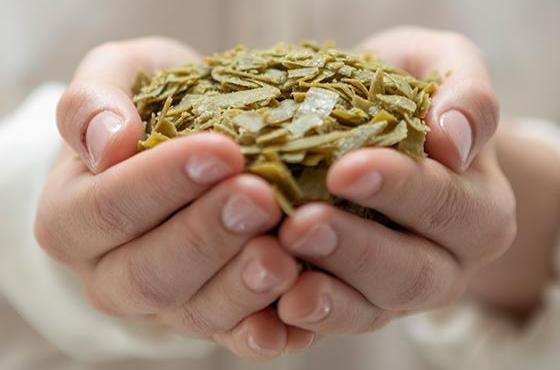
After grating your soap, simply dilute 20g of flakes to make 1L of detergent. We also remind you that it is recommended to use between 75 and 100ml of detergent for 5kg of laundry.
We recommend Marseille Soap for your laundry because it is ideal for skin prone to allergies.
Our Marseille soap is fragrance-free, colorant-free, preservative-free and additive-free. You can get soap directly in flake form, or you can grate a cube or bar yourself. Only 20g is needed to make 1L of detergent.
Our Marseille Soaps are formulated exclusively from vegetable oils, without the addition of preservatives, colorants, fragrance or animal fats. Made from 100% natural ingredients and COSMOS Natural certified, they are guaranteed hypoallergenic.
If you prefer liquid soap, we recommend the "fragrance-free" version which is also hypoallergenic and ideal for gently washing sensitive skin.
Since baby skin is particularly delicate, we recommend consulting a pediatrician.
However, you can use Marseille Soap for baby laundry care. Our Soaps are formulated exclusively from vegetable oils, without preservatives, colorants, fragrance or animal fats.
With its 100% natural ingredients, our Marseille Soap is not contraindicated for skin prone to allergies.
However, we recommend consulting a dermatologist to find the product best suited to your skin.
We recommend using a wire or a large sharp knife without serrations, previously passed under hot water.
Marseille Soap does not expire; you can use it several decades later without any problem. Our Marseille Soap is a living material with a unique color and shape that can vary over time and depending on its exposure to air and light. It will nevertheless retain all its qualities and effectiveness.
Our grandmothers used to let it dry for long months in their cupboards so it would become extra dry and last longer in use.
In the case of purchasing a bar, we generally recommend that our customers slice it upon receipt using a wire or a knife without serrations previously passed under hot water. Indeed, over time, the water contained in the soap evaporates and the bar hardens.
Regarding Marseille Soap crumbs, we recommend not throwing them away: you can use them to make your homemade laundry detergent for example, or you can simply place them in a small cloth bag and use them as you would a bar of soap.
Our Marseille Soaps comply with European Directive 1223/2009 and are therefore vegan. Regarding other Fer à Cheval products, only our Sweet Scented Soap Honey & Almond is not certified vegan because it contains honey in its formula.
Care Range
Soap-free cleanser, the ally of sensitive skin:
Less drying and with a pH close to that of the skin, soap-free cleanser is recommended for fragile and reactive skin. It is also ideal for children's skin and dry skin and can be used daily without the drawbacks of traditional soaps.
Enriched cleanser, cleanse without drying:
The cleanser is enriched, it is enriched with nourishing agents such as sweet almond oil or shea butter for example, which allows it to cleanse the skin without ever drying it. It hydrates and softens the skin while allowing it to retain its natural hydration. By maintaining skin hydration, it helps soothe and prevent itching sensations. And contrary to what one might think, enriched cleanser can obviously be used on the body as well as on the face.
Marseille Soap is made with vegetable oils, water, salt and soda. The oils are saponified at high temperature in a cauldron. Under the action of soda and heat, fats gradually transform into soap.
Even though it has the shape of a classic bar, Solid Gentle Cleanser does not contain soap. Indeed, it is not the result of saponification and therefore cannot be called soap. In this sense, Solid Gentle Cleanser is more similar to liquid shower gel than soap.
Solid Gentle Cleanser is formulated from vegetable oils. The addition of mild surfactants then allows the formula to thicken and obtain a solid texture. The composition of a solid cleanser is more concentrated and contains less water.
Fresh water is lightly concentrated and alcohol-based, making it less irritating to the skin. It compares to a mist for its lightness and more diffuse and invigorating scent. More recommended in spring or summer, its concentration is a maximum of 5% and lasts more than 2 hours on the skin.
Eau de toilette, milder and less concentrated than perfume, is ideal if you are looking for a discreet, more subtle scent than perfume or eau de parfum. Its alcohol concentration is 5 to 15% and lasts on the skin on average 2 to 3 hours.
Eau de parfum is twice as weak as classic perfume, but remains the most concentrated version after perfume (10 to 20% concentration). It impregnates more easily on the skin and fabrics for a scent that lasts all day.
Perfume or perfume absolute is the most concentrated substance (20% pure perfume) that exists.
Alcohol is an essential ingredient for fresh waters. Our vegetable-based alcohol derived from sugar beets is odorless and allows the fragrance concentrate to be fixed and enhances the essences.
In perfumery, alcohol-based perfumes use ethanol which is denatured by synthetic and chemical ingredients. Our alcohol is a more natural alternative to alcohol commonly used in the perfume industry.
Sugar beet alcohol is produced by fermentation and distillation of sugar beet syrup. This alcohol is used in spirits (vodka, eaux de vie, liqueur), as a preservative for vinegar production or as a solvent for dyes or flavors. It is also used for pharmaceutical products, medicines, perfumes or cosmetic and beauty products.
Liquid Soap
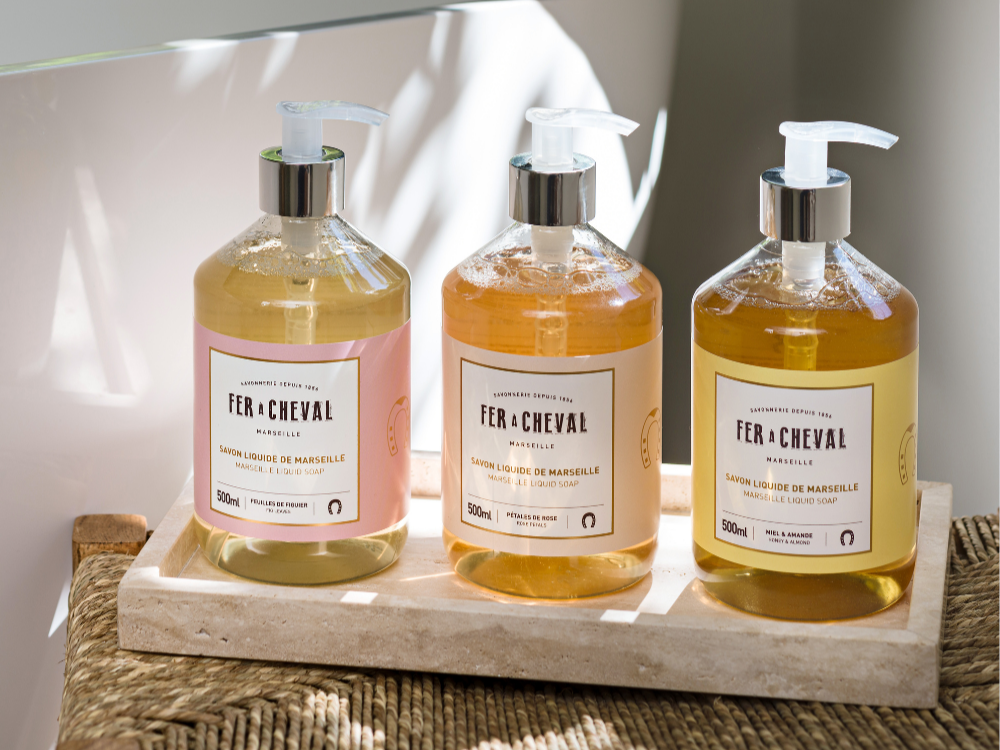
At very low temperatures and particularly in winter, Marseille Liquid Soap can solidify due to its rich vegetable oil composition.
This crystallization is only temporary and does not alter the qualities of the soap in any way.
Simply keep it in a room with a moderate temperature to restore clear liquid soap.
Black Soaps, whether liquid or soft, are made from olive pomace oil, coconut oil (copra), potash, water, salt and preservative. They are made in a cauldron and have the same cleansing qualities. Soft Black Soap is, however, more concentrated (approximately 36% soap compared to 20% for liquid soap). It is therefore more advisable to use Soft Black Soap to degrease barbecue grills or roasting pans for example.